Tag Archives: Star Hopping

Pointing the Way – A Guide to Telescope Finders

Several different telescope finders and finderscopes

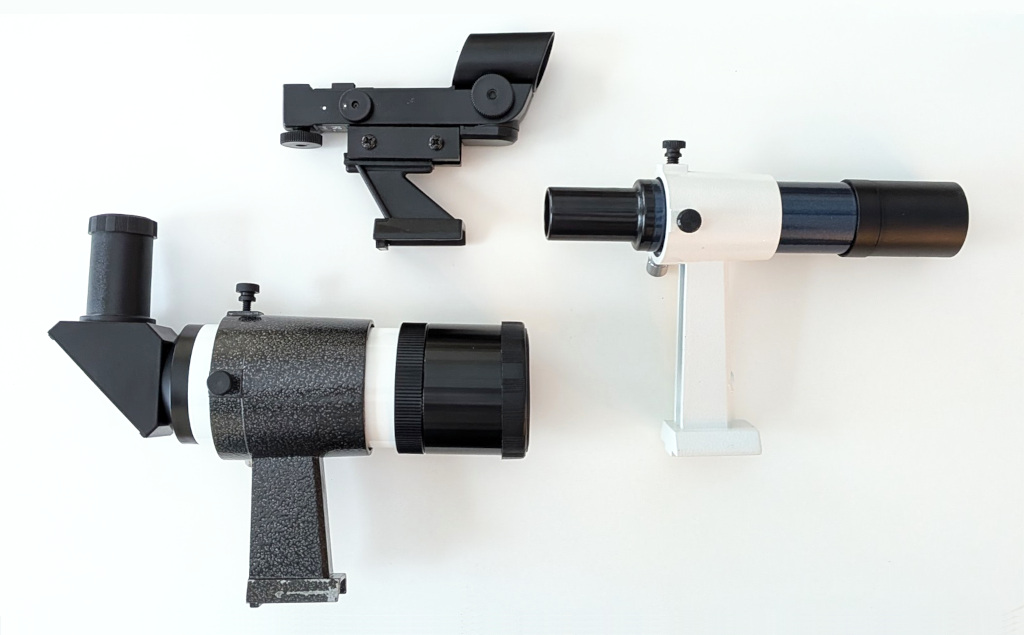
Telescope finders and finderscopes (clockwise, from top): Red dot finder, 6×30 straight-through, 8×50 RACI

In the excitement of selecting a first telescope many beginners overlook the importance of the finder. While finders and finderscopes may not be the most exciting pieces of observing kit they play an essential part in any telescope setup. The night sky holds countless visual treasures but in order to enjoy the enhanced views of these wonders offered by your telescope you’ll need to be able to point it accurately.

Without a good finder the task of getting a desired object within the view of the eyepiece can become a time-consuming and frustrating experience. Most telescopes show only a sliver of the sky at any given time, and even bright objects can prove surprisingly elusive. A finder serves as a bridge between the vast canopy of the night sky and the magnified but confined field of the telescope.

Read more…

The Leo Triplet

Annotated finder chart for the Leo Triplet. Original chart from the TUBA Atlas.

Annotated finder chart for the Leo Triplet. Original chart from TUBA.

During the month of April the constellation Leo is high in the sky shortly after dark, making it a good time to view the many galaxies residing there. As seasoned observers know, viewing galaxies at higher altitudes puts less air between you and the subject giving a clearer view. I’ve spent the past few weeks eagerly awaiting a clear, moonless night so I could revisit M65, M66, and NGC 3628 – collectively known as the Leo Triplet.

After a long stretch of cloudy or moonlit nights, last night’s skies were clear and reasonably dark from my red zone backyard so I brought out my 10″ Dobsonian along with a 5″ refractor to view this trio of Galaxies.

Read more…

Thoughts on Star Hopping

Photo: Star Charts

Star Tools – How do you find your observing subjects?

Star Hopping. For some the term is quaint – an outmoded method of finding things in the night sky. In this day of affordable, accurate computerized mounts that can point your telescope at virtually any object in the sky with the click of an smartphone app why bother with paper charts and manual mounts?

If, in your view, astronomy is mainly about looking at objects in the night sky then it follows that time spent finding things to look at means less time spent looking at them. So why wouldn’t you make the most of your limited observing time by using a computerized mount?

Read more…