The Leo Triplet

Annotated finder chart for the Leo Triplet. Original chart from the TUBA Atlas.

Annotated finder chart for the Leo Triplet. Original chart from TUBA.

During the month of April the constellation Leo is high in the sky shortly after dark, making it a good time to view the many galaxies residing there. As seasoned observers know, viewing galaxies at higher altitudes puts less air between you and the subject giving a clearer view. I’ve spent the past few weeks eagerly awaiting a clear, moonless night so I could revisit M65, M66, and NGC 3628 – collectively known as the Leo Triplet.

After a long stretch of cloudy or moonlit nights, last night’s skies were clear and reasonably dark from my red zone backyard so I brought out my 10″ Dobsonian along with a 5″ refractor to view this trio of Galaxies.

Read more…

Easter Weekend Lunar Eclipse

I missed Saturday morning’s lunar eclipse due to being clouded out in Massachusetts, though had it been clear very little of the Moon would’ve been covered as most of the eclipse occurred after moonset on the East coast.

I’ve only observed one total eclipse; it was November 8, 2003. I remember it because I spent about 2 hours standing out in the cold night with my camera. Here’s a composite of my attempts to photograph it:

Total lunar eclipse on November 8, 2013.

Total lunar eclipse on November 8, 2003.

Matt Wedel was able to observe this weekend’s eclipse from California and has posted some nice photos over at 10 Minute Astronomy.*

*Taken with a 60mm refractor, no less.

-Dave

Original content copyright 2015 by David Philips. All Rights Reserved. This post may contain links to affiliate sites; sales through affiliate links may benefit this site.

Orion StarMax 90mm Maksutov-Cassegrain Review

orion-starmax90mm

During the Summer of 2013 I started learning the constellations and viewing the night sky from my back yard with a pair of 8×40 binoculars. While these show many more stars than can be seen by eye and are great for viewing wide fields, I quickly became interested in closer views of the Moon, planets, and brighter deep sky objects, and began looking for a small telescope.

I wasn’t sure how much use a telescope would see and I didn’t want to dedicate space to a large one so I was drawn to Maksutov-Cassegrain telescopes, which are among the most compact designs, have a reputation for excellent optical performance, and are well suited to viewing the kinds of subjects I was interested in observing.

I found that the Orion StarMax 90mm and Celestron C90 both had many good reviews and seemed to offer great value. They are both made by Synta Optical and use a very similar Optical Tube Assembly (OTA). The main reason I preferred the StarMax was that the included accessories seemed more useful for looking at the sky than those that come with the C90, which is configured as a terrestrial spotting scope.

So in late September of 2013, I purchased the Orion StarMax 90mm Mak as my first telescope. What follows are my impressions from using the telescope over the past year and a half.

Read more…

Viewing the Moon

Photo: Moon

Waxing Gibbous Moon on March 31, 2015

With signs of Spring finally appearing in New England I find my thoughts turning toward observing galaxies. The Lion is well positioned for viewing and I’ve been wanting to write a post on the Leo Triplet but that will have to wait a few weeks thanks to the brightening Moon.

While the Moon’s light does make it difficult to see the faint fuzzies that require dark skies, views of the planets as well as double stars are largely unaffected by the brightened skies and are good subjects between the 1st and 3rd quarters of the lunar cycle. Not to mention the Moon itself – the Moon is the richest object in the sky and time spent examining its treasures is well rewarded.

Read more…

Powering Up – Barlow vs Telecentric Lenses

Photo: ES and TV Telecentrics

Explore Scientific Focal Extenders and TeleVue Powermates are examples of Telecentric lenses. Photos are not to scale.

Most of us have been there. You want more magnification then your lowest focal length eyepiece can give so you turn to a multiplier. But wait – Barlows, Powermates, Focal Extenders? Are these interchangeable in use? If not, how do they behave differently at the eyepiece?

Read more…

Quote: Ken Fulton

“Not all individuals can become astronomers – but anyone who really desires to can become an astronomy enthusiast. Psalm 19:1 states: ‘The heavens declare the glory of God; and the firmament sheweth his handiwork.’ That declaration is not selective, and the show is for everyone who will see.”
— Ken Fulton, The Light-Hearted Astronomer

Ken Fulton’s book, The Light-Hearted Astronomer, was written to help observers get through the critical first year – the period during which so many would be enthusiasts see their passion for viewing the night sky fizzle out and their telescopes sit unused in the closet.* Despite being published nearly 31 years ago and currently out of print** much of what Ken has to say is still relevant today and the book is worth a read if you haven’t yet had the pleasure.

*Having a telescope sit unused can also happen if you have too many telescopes. Not that I’d know anything about that.

**The book can be found used from a variety of sellers.

-Dave

Original content copyright 2015 by David Philips. All Rights Reserved. This post may contain links to affiliate sites; sales through affiliate links may benefit this site.

60mm Sessions: Hunting for Doubles in Orion

Orion

Orion – The Hunter in early Spring. With the exception of Castor, all of the double stars visited during this session can be found in this photo.

When you think of night sky object classes within the grasp of the common 60mm refractor double stars often end up near the top of the list. Like the Moon and planets, many of these multiple star systems are bright enough to cut through light pollution making them easy to view from wherever you happen to be. There are some spectacular double stars in and around Orion and Late Winter / Early Spring is a good time to view them.

Read more…

Using the AWB OneSky as a Travelscope

Editors Note (2026): The AWB OneSky is now sold as the Sky-Watcher Heritage 130 and Celestron Luminos 130 — the optical design, construction, and features are essentially identical so this article applies equally to all three scopes.

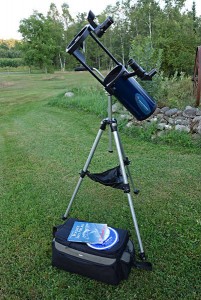
Photo: OneSky travelscope

My OneSky travelscope in action. This photo was taken before adding the shroud described below.

The surest way to improve any telescope’s performance is to get it out under a darker sky. Living in suburban Massachusetts I’d have to drive significant distances to get to skies much darker than the one available from my red zone backyard. The darkest skies I regularly encounter are on family trips to rural areas.

Of course trying to fit a telescope into a car already packed with the whole family and all the associated cargo can be a challenge. Thus begins the search for a more portable telescope or travelscope. To my thinking a travelscope can be any telescope setup that prioritizes volume and/or weight over other concerns such as aperture or mount stability. Every one has their own circumstances and priorities and so travelscopes can look quite different from observer to observer.

As I mentioned in the general review of the AWB OneSky Telescope, my intent when buying the OneSky was to use it primarily as a travelscope. The OneSky appealed to me for its packed aperture to volume ratio and ease of setup.

Read more…

Thoughts on Star Hopping

Photo: Star Charts

Star Tools – How do you find your observing subjects?

Star Hopping. For some the term is quaint – an outmoded method of finding things in the night sky. In this day of affordable, accurate computerized mounts that can point your telescope at virtually any object in the sky with the click of an smartphone app why bother with paper charts and manual mounts?

If, in your view, astronomy is mainly about looking at objects in the night sky then it follows that time spent finding things to look at means less time spent looking at them. So why wouldn’t you make the most of your limited observing time by using a computerized mount?

Read more…

A Look at Losmandy’s New Alt-Az Mount

Photo: Losmandy AZ8

Losmandy AZ8 – The included saddles accept both Losmandy D series and Vixen-style dovetails.

Losmandy is primarily known for their precision manufactured German Equatorial Mounts so it’s not surprising that their announcement of a new alt-az mount based on the venerable GM8 has caused some excitement. The Losmandy AZ8 is a medium sized, heavy-duty alt-az mount featuring twin dovetail saddles for dual-scope capability.

Read more…