Zoom eyepieces offer a compelling proposition to the visual observer. They provide real convenience – a single eyepiece covering a range of magnifications means a more streamlined kit and less fumbling in the dark – but they’ve historically had a reputation for optical compromises.
Over time the gap between a good fixed focal length eyepiece and a quality yet affordable zoom has been growing smaller. I’ve long used a Celestron 8-24mm and other eyepieces of the same design as part of my travel and grab and go observing setups. For the past several years I’ve been using the Svbony SV135 7-21mm zoom with a range of telescopes and found it has some advantages over the older designs.
Design and Handling
The SV135 is currently available in three versions with different apparent fields of view and correspondingly increasing price: 36–52°, 40–57°, and 40–60°. The differences are not huge but they do matter. Of the three, the 40–57° version strikes the best balance. The low end of the zoom range is where you’d like to have a wider field of view for larger objects and there the 40° AFOV is already smaller than ideal.
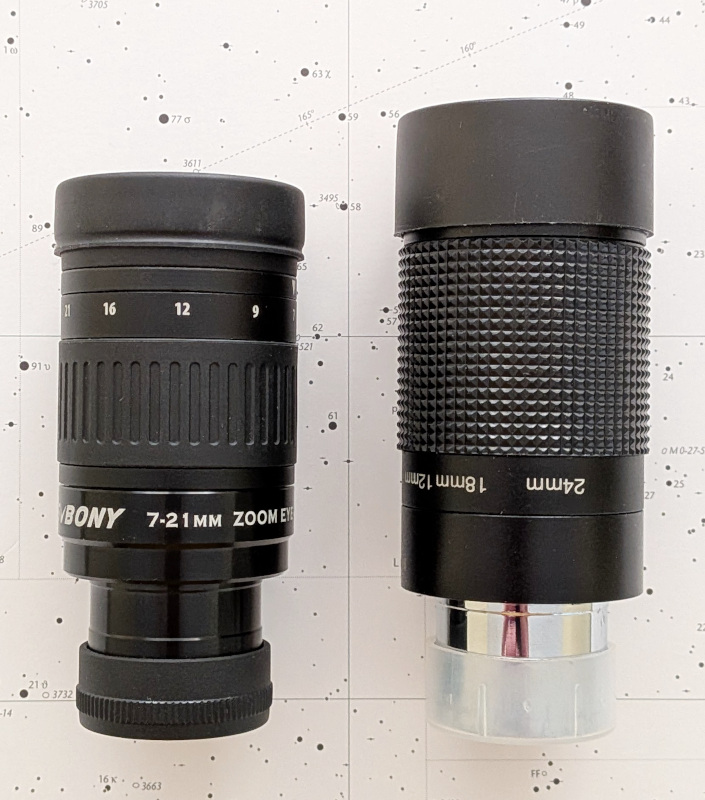
The SV135 zoom is noticeably smaller and lighter than the Celestron 8-24mm.
The zoom action when turning the body is smooth without feeling loose or too light. There are no stops or detents along the travel. Zooming is internal so the eyepiece body doesn’t change externally as you adjust the focal length.
Physically, the SV135 is noticeably smaller and lighter than the Celestron 8–24mm zoom. The lighter eyepiece weight is easier to balance on smaller scopes, and the compact form factor makes it more pocket-friendly for travel. Build quality feels solid without being overbuilt.
It’s worth noting that the SV135 does have a slightly longer barrel than the 8-24mm zooms and some fixed focal length eyepieces. This hasn’t been an issue in use and I have not run into any inability to fully seat the eyepiece on any of my mirror or prism diagonals.
A General Purpose Zoom (Generally)
The magnification of any eyepiece depends on the telescope it is being used with (magnification = telescope focal length / eyepiece focal length). Generally speaking, for the majority of telescopes of common apertures from 80mm – 10″, and the common focal ratios associated with those apertures (f/5 – f/8), the SV135 7-21mm zoom serves as a general use eyepiece. The table below lists magnifications and total field of view offered by the SV135 for a range of telescope designs to give an idea of where it might land with your telescope.
| Aperture, Focal Ratio | Focal Length | Magnification | Total Field of View (40-57° AFOV) |
| 80mm f/6 | 480mm | 23 – 69x | 1.7 – 0.8° |
| 130mm f/5 | 650mm | 31 – 93x | 1.3 – 0.6° |
| 90mm f/13.9 | 1250mm | 60 – 179x | 0.7 – 0.3° |
As you might have noticed, “general use” skews towards the design and strengths of the specific telescope. For a short focal length 80mm refractor the SV135 gives low to mid power magnifications and fields of view suitable for larger open star clusters. By contrast in a 90mm Maksutov-Cassegrain the 7-21mm gives medium to high powers matching the lunar and planetary observing for which this scope is well suited. A 130mm f/5 reflector such as the AWB OneSky sits squarely in the all-rounder category.
It’s also worth noting that in none of the examples above does the 7-21mm cover everything. In most cases you’d want to pair it with a lower magnification eyepiece to maximize your telescope’s total field of view. Adding either a shorter focal length eyepiece or using the SV135 with a barlow or focal extender will provide a way to reach higher magnifications.
Observing Impressions
In use the SV135 provides satisfying views and I have never been conscious of attributing a lack of sharpness to the eyepiece. In fact it seems to give sharper views than the Celestron 8-24mm zooms I previously used.
A high quality fixed focal length eyepiece such as the Explore Scientific 82° series does show a hint more sharpness and contrast along with a wider apparent field of view. Though it’s worth keeping in mind that a single ES82 eyepiece costs two to three times the price of the SV135 and weighs more. When you consider that the SV135 covers the magnification range offered by the ES82 18mm, 14mm, 11mm, and 8.5mm (and nearly gets you the 6.5mm as well) the value offered by the zoom becomes hard to ignore.
The SV135 is also comfortable to use with eye relief and lens diameter that make for easy viewing. I have a hydrogen-alpha solar telescope that is quite demanding of eyepieces due to the smaller sweet spot of the etalon and blocking filter. Because of this I have always used Plossls and lightweight fixed focal length eyepieces with it. I was surprised to find that the SV135 zoom offers easier viewing and more detail than many other eyepieces in my solar telescope. The only exception again being that ES82s can give a small improvement in sharpness and contrast.
Eye relief does vary modestly across the range, reducing from 18.8mm at 21mm to 16.3mm at 7mm as you zoom in to higher magnification, but the change is gradual enough that most observers are unlikely to find it disruptive. The rubber eyecup is soft and flexible enough to be folded down if desired which may be useful for those who wear eyeglasses.
On the Go -or- Grab and Go
The small size and optical quality of the SV135 commends itself well to a travel setup. A compact, three eyepiece kit made up of a low power, wide field eypiece (such as a 32mm Plossl), the SV135 7-21mm zoom, and a barlow or high power eyepiece covers most every situation. That said, when it comes to a grab and go setup for quick looks at home the SV135 may be the only eyepiece you need to bring out the door.
The Svbony SV135 7-21mm zoom offers convenience and good optical quality in a relatively lightweight, compact eyepiece at a surprisingly low cost. It’s an eyepiece that sees a lot of use in my scopes.
-Dave
Original content copyright 2026 by David Philips. All Rights Reserved. This post may contain links to affiliate sites; sales through affiliate links may benefit this site.